
The three pillars of civil resistance: Lessons from the Twin Cities
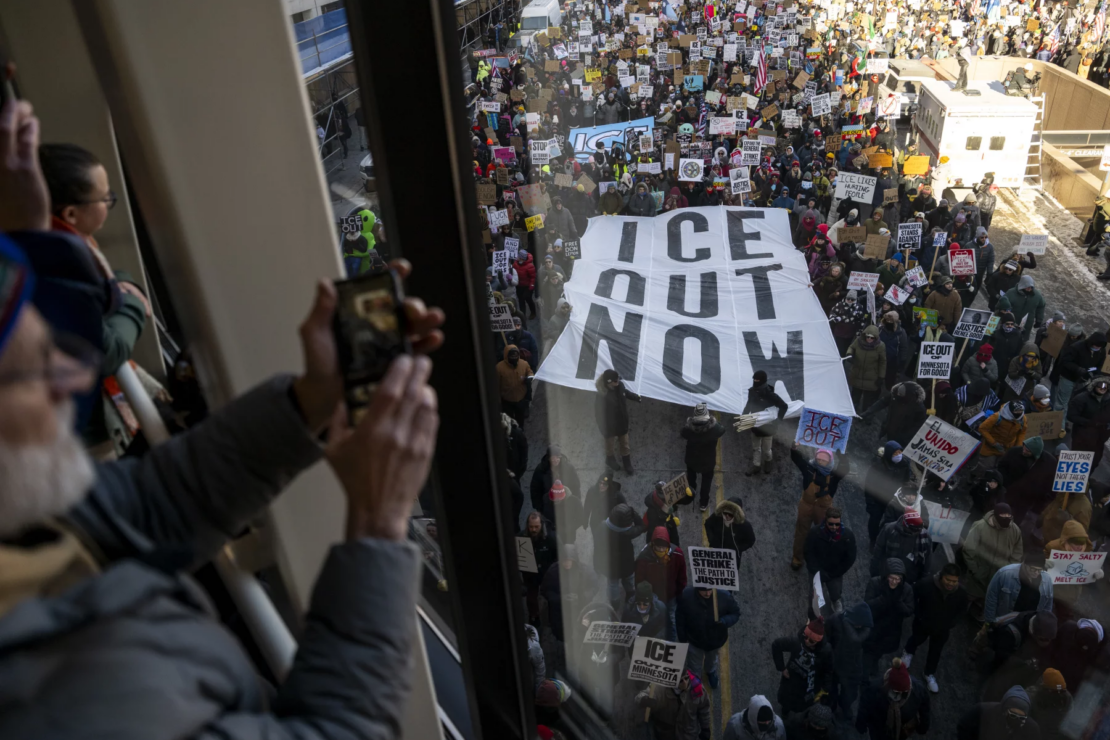
Op-ed: What happened here can still happen in other cities. Local leaders should act now to ensure that the worst outcomes can be forestalled and resisted. Photo by Stephen Maturen/Getty Images.
On a cold morning in Minneapolis last winter, one of us stood outside a local school to ensure that all children and families could move safely to and from school without fear. Bill was there not as an official or community organizer, but as a concerned neighbor alongside other parents, volunteers, and community members.
ICE’s brutalization of our people in the Twin Cities drew plenty of attention in the media and elsewhere. But what mattered most that cold day, and so many other days this winter, was not quite as public. It was what happened somewhat invisibly: the networks that formed and solidified, the neighbors checking in on one another, the volunteers coordinating behind the scenes, the nonprofits and small businesses organizing in real time.
These networks existed in nascent form before the federal invasion of Minnesota. Under federal pressure, they only became stronger, more hyper-local, and more resilient.
What emerged in Minneapolis and St. Paul, and what continues today, offers a crucial lesson that local leaders across the country cannot afford to ignore.
Protecting a free and civil society requires three pillars working in concert: brave people, willing organizations, and robust public space. The Twin Cities didn’t build these overnight. But when the moment came, all three were ready.
Democracy depends on civil society
A functioning democracy requires more than laws and elections. It requires people moving freely, encountering one another, speaking and participating in shared civic life. The authors of the Constitution understood this, and thus the right to assemble was outlined in the First Amendment.
Democracy, in some cases, depends upon the existence of places where civic life could unfold.
Violence empties these public spaces when federal agents are allowed to determine who does and does not belong. The impact of our communities’ fear ripples outwards. Speech contracts, connection weakens, trust erodes.
Public space does more than host civic life; it produces the relationships that sustain it. The trust, familiarity, and informal networks that emerge from everyday encounters in parks, sidewalks, schools, and commercial corridors are what make rapid, coordinated civic action like that in the Twin Cities possible.
In other words, the ability of a community to respond, organize, and protect itself is not built in a moment of crisis. It is a foundation built over time, in the shared spaces where people come to know one another. In the Twin Cities, three interconnected pillars uphold that foundation.
The human network
The most visible element of the Twin Cities response was people showing up.
While ICE targeted Black, Brown, and vulnerable communities, volunteers organized school watches. Neighbors maintained a presence in parks and along key street corridors and sidewalks. “Commuters” tracked federal enforcement activity across neighborhoods, sharing information in real time.
Mutual aid systems operated in parallel. Volunteers delivered food and supplies to households sheltering in place. Others coordinated rides to medical appointments or immigration check-ins. This network operated school by school, block by block, park by park. And it was entirely voluntary.
The speed and scale of this mobilization were not incidental. They were the product of a civic culture shaped by years of organizing, high levels of civic participation, a dense nonprofit ecosystem, and strong immigrant communities with deep traditions of organizing and mutual support. Widescale individual and organizational response to the murder of George Floyd further strengthened these networks, creating relationships and capacities that could be activated again when needed.
There is also a less discussed dimension: the personal impact of participation. Showing up for neighbors is not only protective—it is connective. For Bill himself, it has been cathartic to do this. In moments of uncertainty, civic action became a way to reassert belonging, human connection, and shared purpose.
The connective tissue
People alone are not enough. What allowed the human network to function at scale so effectively was a second pillar: organizations and communications systems built over years.
Nonprofits and advocacy groups across the Twin Cities had spent years building trust, relationships, and operational capacity. When the moment came, their networks could be activated quickly and effectively. Their volunteers were not starting from scratch, and to some extent they could plug into (and adapt) existing systems.
Small, locally-owned businesses also played a critical role, offering places to gather, organize, and sustain community presence. In many cases, they did so before formal political responses materialized, often at significant financial and personal risk.
These systems and organizations were reinforced by a decentralized but highly effective communication infrastructure. Signal groups, real-time alert systems, license plate tracking, supply coordination, and fundraising platforms created a shared operational picture across neighborhoods. Information moved quickly and resources followed. This infrastructure did not emerge spontaneously. It was built incrementally, carefully, through prior investments in organizations, tools, and relationships.
For local leaders, the implication is clear: supporting community-based organizations is not peripheral to governance, but central to the resilience and success of civil society.
Our common ground
The third pillar needed to protect civic society and democracy is the ground we stand on. People and networks organize in service of something: the ability to move freely through shared space, to gather, to encounter others, to live publicly. Public space is where civic life happens. Without it, the other pillars cannot reach their full potential.
In the Twin Cities, community members stationed on sidewalks, outside schools, and in parks were not only protecting individuals. They were maintaining the conditions for public life to continue. This represents a shift in how the concept of public safety is understood.
Traditionally, the protection of public space has been assigned almost exclusively to formal enforcement systems. The model that emerged here is different: resident-led, relational, and rooted in place. But this approach also exposes a tension that local leaders must confront.
The Twin Cities has demonstrated an extraordinary capacity to mobilize people and networks, and this mobilization of people is essential. However, ensuring all neighborhoods have access to well-maintained, vibrantly programmed, welcoming and engaging public spaces is equally essential.
Minneapolis and St. Paul are nationally known for having rich public realms, but they also have some of the worst racial disparities in the nation. The cities have been and continue to be difficult places for people of color; the federal invasion is just the latest example of how the inequity is working.
Our environment has the potential to be used as a foundation for change, but it requires political will. It requires a willingness to disrupt status quo investment patterns, prioritize civic infrastructure, and commit sustained resources to the spaces that anchor public life.
An invitation and a warning
The lessons we have learned are not unique to the Twin Cities. We believe they are transferable, if and only if local leaders adopt these priorities before it is too late:
Invest in people. Supporting the more radical conditions that allow civic networks, including immigrant communities, neighborhood associations, and informal organizing structures, to form and thrive is critical. Early investments and planning are necessary, as systems change cannot happen overnight.
Strengthen the connective tissue. More varied sources of funding and support for the nonprofit organizations and systems that coordinate community response and provide services also enables the local infrastructure that allows information, resources, and support to move quickly and effectively in a crisis.
Bolster public space. The parks, libraries, trails and community centers in every community, what we call civic infrastructure, should be treated with the same seriousness of purpose as physical infrastructure like roads and utilities. Investing in design, programming, and management of these places will make shared spaces accessible, safe and welcoming across divides of race, class, age and belief, and will provide places for people to connect and organize in a crisis.
Those 2,200 federal agents did not leave the Twin Cities to return to their homes. They are relocated elsewhere, and what happened here can still happen in other cities. Our road to economic and social recovery is long. Local leaders can and should invest in laying the groundwork to ensure that the worst outcomes can be forestalled and resisted.
From the Twin Cities, the message is one of both caution and solidarity. This work is difficult. It is exhausting. And it is deeply meaningful. For policymakers, civic leaders, and people who love their communities, the time to build these systems is not when the crisis arrives. It is now.
This article originally appeared in Next City.