Clean Air Minnesota’s strategic refresh: What’s next and how you can help
Following a proactive strategic refresh, Clean Air Minnesota (CAM) partners have sharpened the partnership’s efforts for the years ahead and are digging into new ideas to reduce emissions collaboratively.
For more than two decades, Environmental Initiative has brought together business, government, health, community, and nonprofit leaders to improve air quality across the state through CAM. The partnership focuses on voluntary action to reduce fine particulate matter (soot) and ground-level ozone (smog). We’ve focused on practical strategies that address smaller, dispersed, and less regulated sources like diesel vehicles, small business operations, and wood smoke.
Through CAM, we prioritize emission reduction strategies, implement projects, track pollution reduction outcomes, and learn from one another. Over the past two years alone, CAM’s efforts have reduced more than 26 tons of volatile organic compounds (VOCs), 24 tons of nitrogen oxides (NOₓ), and 2 tons of fine particulate matter (PM2.5).
Why a strategic refresh?
Despite CAM’s successes, the landscape continues to shift. In Minnesota, air pollution disproportionately affects low-income residents, Indigenous communities, and people of color. A new law designed to help communities that face higher levels of pollution may require some businesses seeking air permits to conduct analysis of the cumulative impacts of pollution. At the federal level, guided by the latest public health research, the PM 2.5 standards were lowered from 12.0 to 9.0 micrograms per cubic meter, putting Minnesota on the edge of noncompliance. * And within CAM, as is natural for any organization, longtime leaders have retired.
In this context, CAM set aside its regular activities to engage the partnership in a proactive, strategic conversation about the future. Over several months, we stepped back to consider key questions: What are the most urgent challenges we face now? Where can this partnership have the greatest impact in the years ahead? What project or collaboration opportunities might we be overlooking?
Process overview
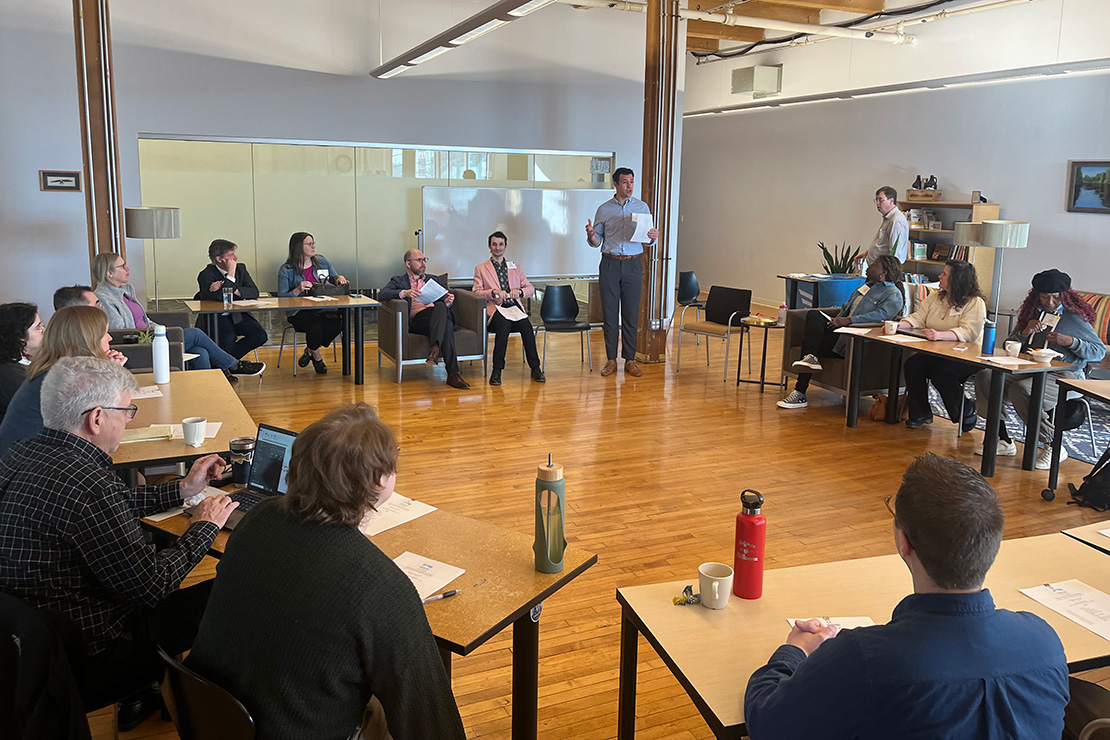
Environmental Initiative led partners through a multi-step process to explore and identify emerging air quality challenges and focus areas for the partnership between December 2024 – May 2025. The process included online surveys, small group meetings, and two larger half-day workshops to:
- Assess the current state: We reviewed CAM’s history, major milestones, and stakeholder maps to ensure we understood the current landscape.
- Explore drivers of change: Our team identified different forces of change, or drivers, shaping the future of air quality. During a half-day workshop, participants explored uncertainties, discussed potential outcomes, and identified the most important drivers to include in our scenarios.
- Develop end explore scenarios: We used scenarios to explore how different combinations of drivers could shape plausible futures. These future scenarios were designed to stretch our thinking, challenge assumptions, and support more informed strategic decision-making.
- Prioritize focus areas: A wide range of potential project ideas and focus areas emerged from workshop and small group discussions. Environmental Initiative staff and key process partners evaluated and refined these ideas.
Highlights for our team were the in-person workshops. It is rare to have large blocks of time dedicated to conversation and strategic thinking. We are grateful to everyone who participated by investing their time and energy into what we might achieve for cleaner air by working together.
What’s next for Clean Air Minnesota
The most important step is what comes next: shaping these new focus areas into funding-ready pilot projects between now and early 2026. Focus areas that emerged from the process include:
- Activate local capacity: Collaborate with frontline communities to co-design and deliver training, partner activation, and technical support to plan and implement clean air projects in parts of the state most impacted by air pollution.
- Recognize business leadership: Explore developing a program that highlights businesses who are voluntarily taking steps to improve air quality and encourages others to follow.
- Incorporate indoor air quality: Expand CAM’s work to address air quality inside homes, schools, and public buildings.
Environmental Initiative is forming small working teams to shape these ideas into on-the-ground projects. If you’re someone with experience or connections in the following areas, we want to hear from you:
- Community outreach & engagement
- Communications
- Indoor air quality
- Entrepreneurship or new project development
Team members will commit 2–4 hours per month to virtual meetings and materials review. You’ll be part of a small, cross-sector team supported by Environmental Initiative staff. Work begins this summer and continues into early 2026. Stipends are available for community partners.
Environmental Initiative will also reconvene working groups focused on reducing emissions from area sources, mobile sources, and wood smoke. These groups will meet quarterly.
Contact Eben Kowler with questions or to express interest in volunteering.
*As of March 2025, the Trump Administration is revisiting the PM 2.5 National Ambient Air Quality Standards (NAAQS).