
A resilience playbook takes shape in Payne-Phalen
The Climate Smart Communities Initiative (CSCI) has announced its 2026 grant cohort: 28 awards totaling $3.1 million, the largest number of projects the program has funded in a single year. Among them is a $115,000 award to Saint Paul’s Payne-Phalen neighborhood, where existing Clean Air Minnesota (CAM) relationships helped bring together the partners who turned an idea into a funded project.
The award will fund a resilience playbook for Payne-Phalen, led by WSB as adaptation practitioner, the Payne-Phalen Community Council as community partner, and the City of Saint Paul as government partner. Over the next year, the team will validate priority hotspots, assess neighborhood “lifeline” assets like schools and community spaces, and build a prioritized portfolio of projects addressing extreme heat, air quality, and severe weather. They will pay special attention to situations in which those risks overlap, such as extreme heat events compounded by wildfire smoke.
Clean Air Minnesota’s role
Clean Air Minnesota is a cross-sector partnership Environmental Initiative has convened for more than two decades, bringing together business, government, health, community, and nonprofit leaders around voluntary reductions in fine particulate matter and ground-level ozone. In 2025, CAM undertook a strategic refresh to identify where the partnership could have the greatest impact going forward. One priority that came out of that process is activating local capacity: collaborating with frontline communities to co-design the training, partner activation, and technical support needed to plan and implement clean air projects in the parts of the state most affected by air pollution. The CSCI award is an early example of that work.
CAM’s existing cross-sector infrastructure kickstarted the funding application for this project. When the grant was released, Eben Kowler, partnership manager at Environmental Initiative, reached out to the Payne-Phalen Community Council about an idea that had come up at a CAM workshop in late 2025.
“This project didn’t start from scratch. It started from a conversation we’d already had, which is the advantage of the long-term, cross-sector partnerships that make up Clean Air Minnesota,” Kowler said.
From there, the team came together quickly. Kowler reached out to WSB, an Environmental Initiative partner, for adaptation support, then connected with Ramsey County, a CAM member. The county provided climate risk data and mapping to support the application and connected the team with the City of Saint Paul, which will align the project with its Climate Action and Resilience Plan as a government partner.
The air quality impacts
Air quality is central to why Payne-Phalen needs this work. The neighborhood sits near Interstate 35E and Highway 61, adding near-road pollution exposure on top of a documented respiratory burden. Minnesota Department of Health data on asthma-related emergency department visits and COPD hospitalizations show elevated rates in the area. Wildfire smoke is also a growing contributor to fine particulate matter across Minnesota, adding yet another air quality impact in a neighborhood already coping with high pollution.
The playbook may also explore interventions such as cleaner-air community spaces and resilience hubs, filtration and cooling upgrades at lifeline assets, strategies to reduce exposure on high-pollution days, and nature-based solutions like vegetated buffers along major roadways and dust-control vegetation on vacant lots.
What’s next
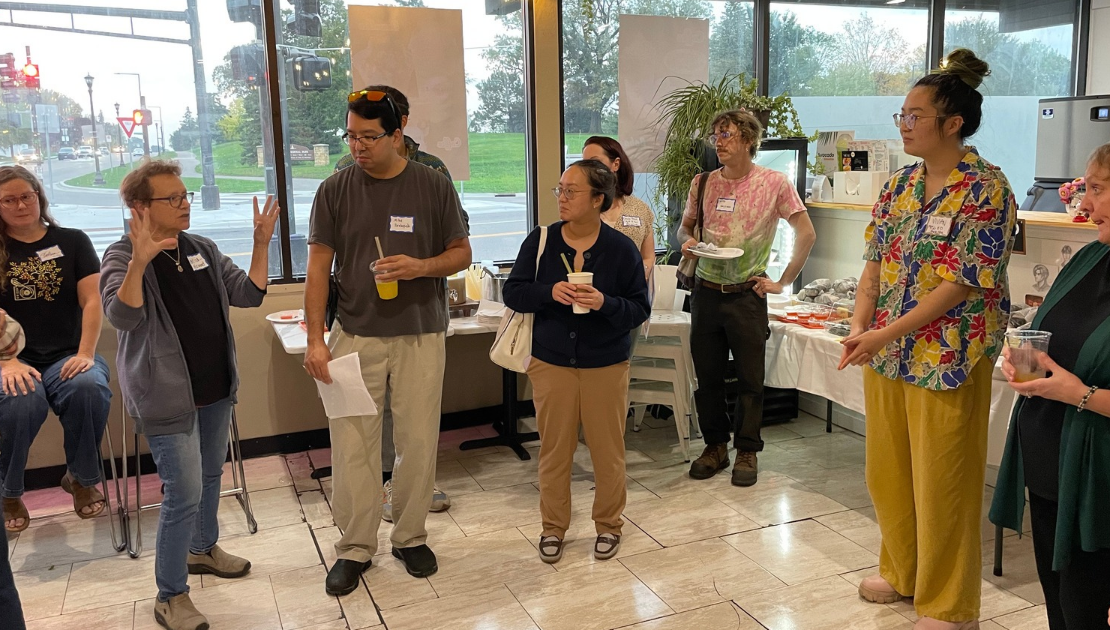
Payne-Phalen community members recently had the opportunity to meet the team behind the upcoming resilience playbook at a kickoff event in Saint Paul celebrating the CSCI award. The room was full at SunMoon Boba & Cafe, with elected officials, city staff, and longtime climate organizers in attendance, including people who were part of some of the earliest conversations about the project.
In the near term, Environmental Initiative will stay engaged through individual conversations and meetings with interest groups as the project moves from ideation through playbook creation. Longer term, there may be opportunities for Environmental Initiative and CAM to help implement projects that come out of the playbook, or to bring this community-level clean air planning approach to other neighborhoods facing similar risks. Stay tuned for updates as the project unfolds.
About Environmental Initiative
Environmental Initiative is a 501(c)(3)3 nonprofit organization based in Minneapolis that catalyzes collaboration across perspectives, power, and systems for social equity and environmental health. They have convened Clean Air Minnesota (CAM) for 23 years, a cross-sector group of air quality leaders developing and implementing strategies to improve air quality in Minnesota’s most impacted communities. For more information about CAM and the rest of Environmental Initiative’s clean air projects, explore Our Work.