
Wildfire smoke and health in Minnesota: What you need to know
Wildfire smoke has increasingly affected Minnesota’s summer air quality, making decisions about outdoor activities harder for caregivers and youth program directors alike.
We sat down with two state experts, Jessie Carr, epidemiologist supervisor at the Minnesota Department of Health (MDH), and Matt Taraldsen, supervisory meteorologist at the Minnesota Pollution Control Agency (MPCA), to learn what’s driving these changes, how smoke affects our health, and how families and youth programs can prepare.
These interviews have been edited for length and clarity.
It feels like wildfire smoke is becoming more common in Minnesota. What’s changed?
Matt: It really comes down to drought — here in Minnesota, across the upper Midwest, and in northern Canada — which has put enormous stress on the boreal forests and set the stage for active fire seasons. We’ve had poor air quality events basically every year since 2018. The years we’ve been hit hardest — 2021, 2023, 2024, 2025 — all had persistent northwesterly winds pulling smoke directly into Minnesota.
What makes wildfire smoke more dangerous than typical air pollution?
Matt: Wildfire smoke is classified as fine particulate matter (PM2.5), but it also carries a range of gases like carbon monoxide and formaldehyde. That combination appears to cause greater health impacts at lower concentrations than standard pollution.
What are the health risks of exposure to poor air quality?
Jessie: Fine particulate matter is small enough to pass from the lungs directly into the bloodstream, which is why we see effects across multiple body systems. Short-term symptoms can include eye, lung, and throat irritation, as well as asthma attacks and other breathing problems. Headaches, dizziness, and fatigue are also signs your body is reacting. Because particles work cumulatively, symptoms can lag two to five days after exposure, making multiple consecutive smoke days especially concerning.
Longer term, poor air quality is linked to serious health impacts, including heart disease, heart attacks, stroke, and even premature death. It’s also associated with increased risks of cancer, dementia, and other cognitive and mental health issues. Fine particle pollution has also been linked to preterm birth and low birth weight. However, the health impacts of wildfire smoke are an emerging area of research that scientists are still working to better understand.
Who is most at risk?
Jessie: The Air Quality Index, which is the color-coded EPA tool used to communicate about outdoor air quality and health, uses the term “sensitive groups” to describe people more at risk of health impacts. Sensitivity can come from physiology, age, how much time you spend outdoors, where you live, your occupation, or existing health conditions.
Sensitive groups include:
- All children under 18 — their cardiovascular, respiratory, and brain systems are still developing, they take in more air per body weight than adults, and they tend to spend more time outside.
- Pregnant people — they metabolize pollutants differently and have increased air intake.
- Adults 65 and older — often due to coexisting health conditions.
- Outdoor workers and people doing vigorous outdoor exercise.
- People with repeated or elevated background exposure to air pollution — exposures build cumulatively.
- People with conditions like asthma or heart disease — smoke can exacerbate otherwise well-managed conditions.
You mentioned the Air Quality Index. What is that?
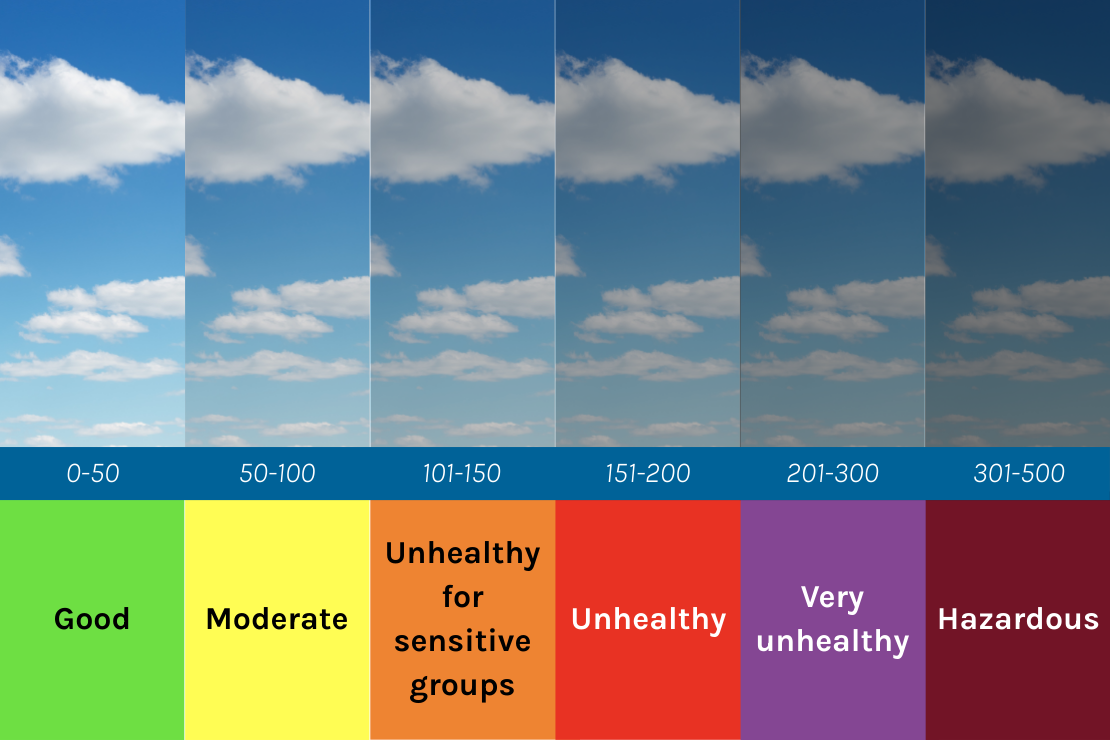
Matt: AQI stands for the Air Quality Index — it’s a simple way to show how polluted the air is and what that means for your health. It turns complex data into a 0–500 scale with color-coded levels — from green (good) to maroon (hazardous) — so you can quickly tell if it’s a good day to be outside.
It tracks pollutants like ozone and fine particles, using both a 24-hour average and the three worst hours of the day. Whichever is higher determines the color, so a mostly orange day that spikes to purple will be called a purple alert.
Some smoky days won’t trigger an alert if the 24-hour average stays below the threshold. Alerts also cover both ozone and fine particle pollution — two different pollutants that require different ways to protect yourself.
Where should people go for reliable air quality information?
Matt: AirNow.gov or the AirNow app is the best one-stop source — it pulls together official data from agencies across state lines. The MPCA website is also a reliable option.
Should I trust the AQI on my phone’s weather app?
Matt: It depends. Some apps use official data; others use modeled indices that can over- or underestimate. I’ve gotten alerts on my own phone that I didn’t issue. If you get an alert through a weather app, check the source — official Minnesota alerts come from MPCA and are relayed by the National Weather Service. When in doubt, go to AirNow.gov or the MPCA website.
How should people make decisions on poor air quality days?
Jessie: Start by knowing your risk, checking the AQI, and familiarizing yourself with what the AQI colors mean. When air quality is poor, find ways to be safe if you go outside, stay indoors when you can, and know when to seek medical care. The biggest mistake people make is simply not checking and assuming smoke only affects those with asthma. Even healthy adults can feel the effects for days after a single heavy exposure.
Why are children especially vulnerable?
Jessie: Children’s lungs, heart, and brain are still developing. Because of their smaller body size, they take in more air per pound of body weight than adults. And they tend to spend more time outside. All of these factors together make all children a sensitive group regardless of whether they have a prior health condition.
What symptoms should caregivers watch for on smoky days?
Jessie: Watch for itchy eyes, coughing, shortness of breath, headaches, dizziness, fatigue, or kids who just seem “off.” Some symptoms ease with rest, but when they persist, it’s time to seek medical care — ideally before reaching a full asthma attack. These symptoms can appear in children with no prior health conditions, so caregivers should be watching all kids, not just those with known diagnoses.
How should youth programs, camps, and schools respond to poor air quality days?
Jessie: MDH has health guidance and checklists specifically for youth program leaders on our website at mn.gov/wildfiresmoke.
The key is to check the forecast and plan ahead. Decide in advance at what AQI level you’ll bring kids inside. Have masks available, ensure caregivers know to send kids with rescue medications, and communicate a clear rescheduling policy with your community.
Think of it the way programs already handle lightning: know the threshold, know the plan, and communicate it clearly so everyone knows what to expect. That advance planning saves a lot of last-minute scrambling, especially for programs with younger staff who aren’t positioned to make the call on their own.
At what AQI level should outdoor activities stop?
Jessie: At AQI 150 and above — Red, Purple, and Maroon — the air is unhealthy for everyone. MDH guidance, consistent with the Environmental Protection Agency and other state health departments, recommends refraining from outdoor activities at these levels. If you do need to be outside, minimize time and take precautions appropriate to your situation.
Do masks help? If so, what kind?
Jessie: A well-fitted N95 or KN95 is effective at filtering fine particles and is a good option if you need to be outside for an extended period. Surgical and cloth masks are not effective for this purpose. But keep in mind that masks are hard to keep on kids in real-world settings. The key is having a reasonable plan to protect yourself and your family based on the conditions—whether that means limiting time outdoors, using a high-quality mask when it makes sense, or adjusting activities until air quality improves.
What are simple ways families can protect indoor air?
Jessie: Two goals: filter the air, and don’t create new pollution inside. Avoid candles, frying or charring food, and vacuuming on smoky days — all release particles, and on smoky days you won’t be able to ventilate by opening windows. To filter air, use central HVAC with a MERV 13 filter, set window AC units to recirculate, or run a standalone air purifier. Making a DIY Corsi-Rosenthal box, which is a box fan with a furnace filter attached, is a highly effective and low-cost solution.
Is this the new normal for Minnesota summers?
Matt: Probably not in the long run, though the short term will still be bumpy. As burned areas in Canada regenerate, forests are evolving toward more deciduous species that are more drought, fire, and heat-resistant. Nature is adapting. Just because it’s been happening doesn’t mean it will keep happening.
Any final thoughts?
Matt: Treat air quality like any other weather hazard. Check AirNow.gov, the MPCA website, or mn.gov/wildfiresmoke, and pay attention to alerts when they’re issued. It also helps to have a plan before smoke arrives: monitor conditions, use a checklist, and build air quality into how you think about the weather. As we like to say, “Be prepared, but don’t be scared.”
Resources to create your own air quality plan
- AirNow.gov – Real-time AQI by location (U.S. EPA), or sign up to receive AirNow Air Quality Notifications
- Current Air Quality Conditions (Minnesota Pollution Control Agency)
- Wildfire Smoke: A Growing Health Concern (Minnesota Department of Health)
- Minnesota Outdoor Air Quality Guidance for Schools and Child Care (Minnesota Department of Health)
Note: MDH guidance reflects the best available science and is consistent with EPA and other state public health agencies. It is guidance, not a mandate; individuals and programs should weigh their own circumstances when making decisions.